OLD TOWN BASEL
Of Nature and Architecture
ON MÜNSTER HILL
Meeting place: On the Pfalz, behind the Münster
End: Garten der alten Universität, Rheinsprung 15
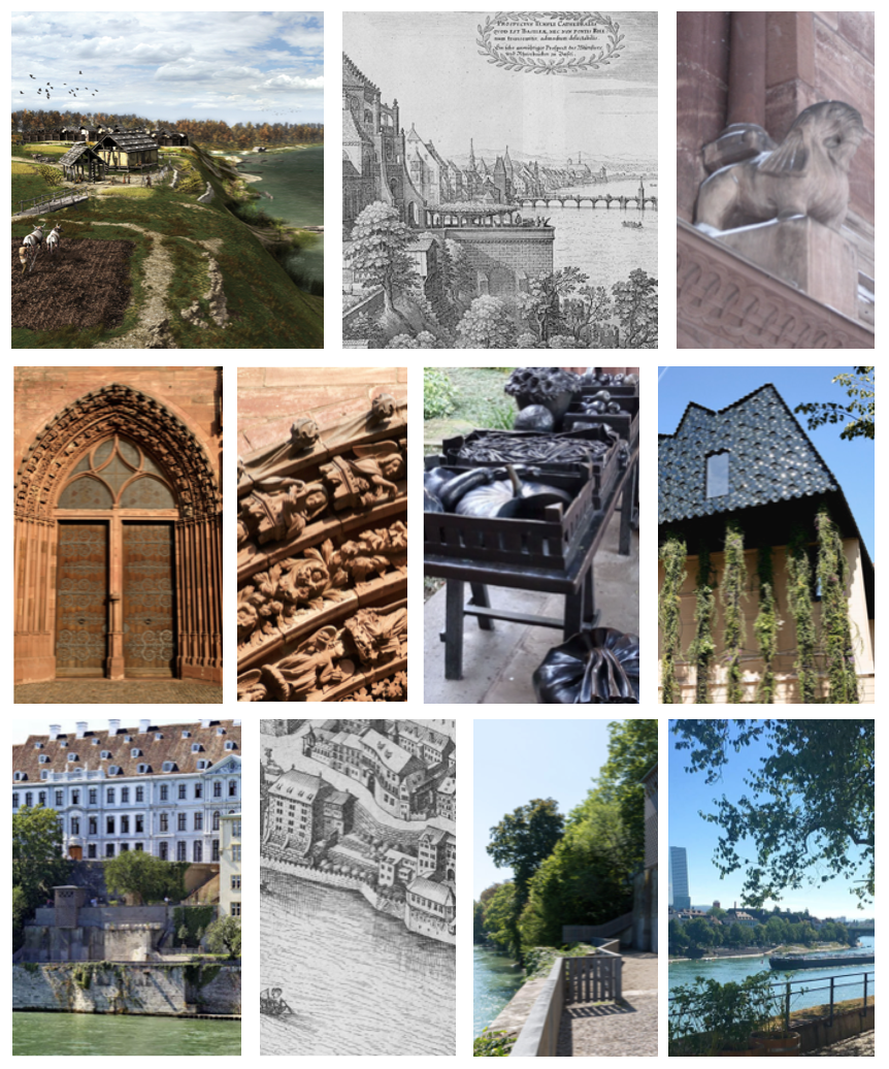
The first in the series of walks focusing on the relationship between the natural and the built world takes us to Basel’s historic heart. We meet on the Pfalz, high above the Rhein; here we will compare the view of today’s city with images depicting the area at the time it was first settled, thousands of years ago. How did the river get its “knee,” how did it influence the construction of the Mittlere Brücke, or the terracing of the steep slope behind the Münster?
Strolling around the Münster, we look at the way architectural ornament stylises elements from nature. We discuss the symbolic importance certain plants had in medieval times and try to use our botanical knowledge to decipher intricate stone carvings of the Münster’s main portal. Fast forwarding to the 20th century, we address a more sinister aspect of our relationship to nature, as interpreted by Bettina Eichin’s Market Tables in the Münster’s Cloister.
On the other side of the Münsterplatz, we look at Herzog & de Meuron’s Museum der Kulturen, its hanging plants and the way their setup has been received by the public. We walk further along Augustinergasse, past Melchior Berri’s 19th c. Museum and the Baroque Blaues- and Weisses Haus. Our tour ends with a visit to the recently reconstructed park with roots in the 16th century. Laid out as Basel’s first botanical garden (Hortus medicus), used later as the Sarasin family’s pleasure garden (Lustgarten), half-hidden on the narrow terraces below the Rheinsprung it can now be enjoyed by all.
K L E I N B A S E L
Meeting place: Wettsteinbrücke, Kleinbasel side
End: Kaserne, Unterer Rheinweg
Meeting place: Wettsteinbrücke, Kleinbasel side
End: Kaserne, Unterer Rheinweg
This walk takes us to through the part of Basel that was laid out as a planned settlement in the 13th c., after the first bridge across the Rhein was constructed. Although the defence walls that were built soon afterwards do not exist any longer, a former monastery complex and buildings constructed on the grounds of a former convent display some architectural characteristics that can help us imagine how the southern and the north-western corners of Kleinbasel’s medieval fortifications might have looked like. These two complexes - the 15th c. Carthusian monastery and the 19th c. Kaserne built on the grounds of the 13th c. Dominican convent - also mark the beginning and end of our walk.
We meet on the Kleinbasel side of the Wettstein bridge and look first at the Kartause - the Carthusian monastery converted after the Reformation into a town orphanage. We talk about the archaeological findings from the area of the Theodorskirche and continue along Lindenberg to the courtyard of the Hattstätterhof - a late-Gothic residence displaying castle-like features not typically seen in Basel. Our itinerary also includes the site of the 13th c. Riehentor and takes us further along Claragraben - a former defence moat, today a busy street lined with several impressive 19th c. buildings. We compare today’s Claraplatz with historic depictions of the medieval cloister of Poor Clares and have a look at the Clarakirche. On our way towards the river, we visit the nearby Volkshaus and discuss its ongoing renovation by Herzog & de Meuron. Our tour continues along the Rhine promenade where we look at the buildings that used to be part of the 13th c. Klingental convent, its cloister gardens replaced in the mid 19th c. by military quarters of the Kaserne. We end the tour by discussing the Kaserne reconstruction project which will open the building and connect the complex’s inner court with the Rhein promenade.
From the Archives ...
© 2024 architecture walks and talks